I Attended “Adult Terakoya: Stone Jizo Statues of Naramachi” at Tokuyuji Temple in Nara
 kochizufan
On March 1, 2025, I attended “Adult Terakoya: Stone Jizo Statues of Naramachi”, held at Tokuyuji Temple in Nara.
The lecturer was Professor Shinichi Sagawa of the Department of History and Culture at Osaka Ohtani University.
Nara Jizo Project
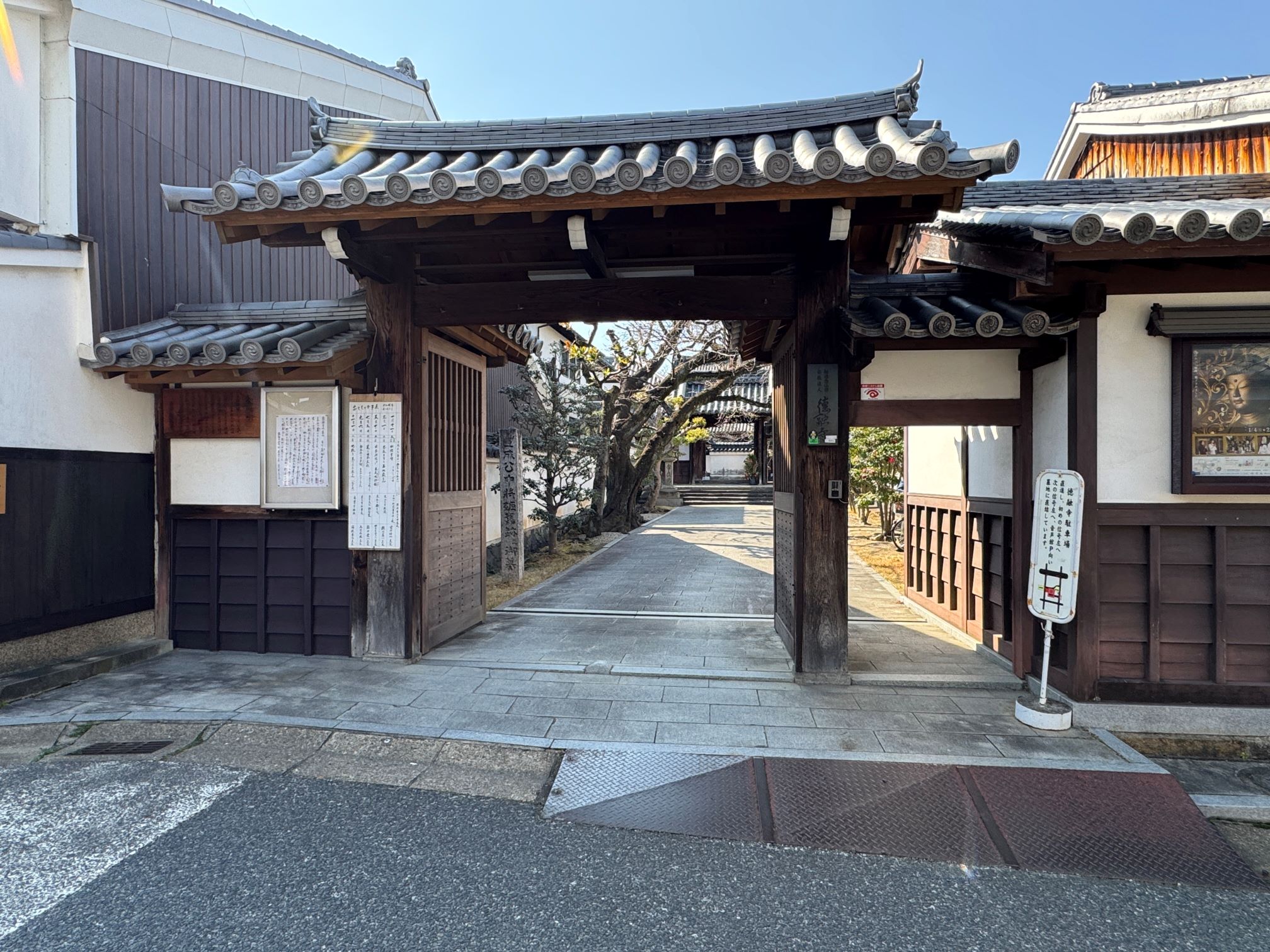
Since around 2016, Code for History has been working on the Nara Jizo Project, which maps Jizo statues—and other small sites related to local religious practice—throughout Nara City.
The project began because we sensed that Jizo worship in Nara had some distinctive characteristics.
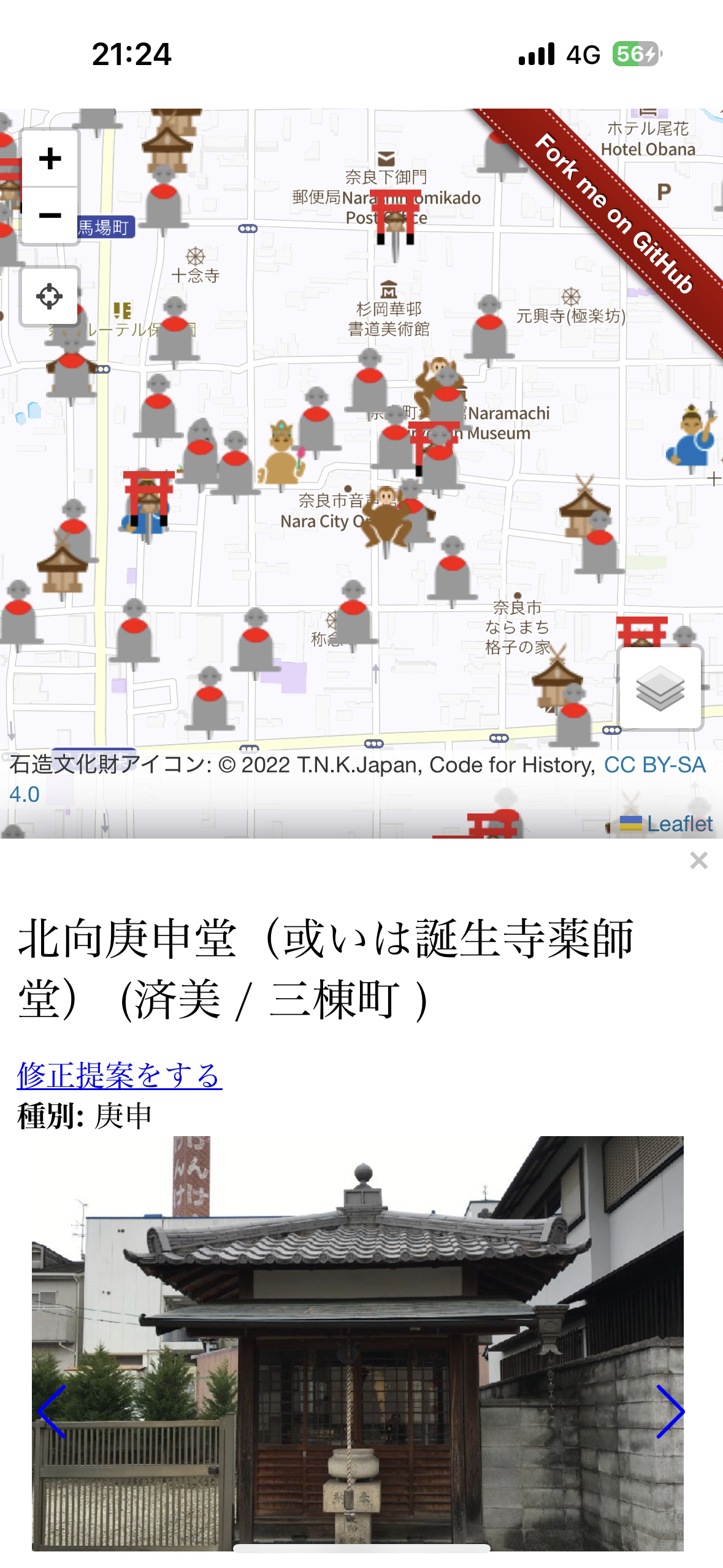
Through this work, we had already noticed several unusual features of Jizo statues in Nara.
- Small Jizo statues—or stone objects treated locally as Jizo—are enshrined all over the city, often on street corners rather than within temple grounds.
- They appear with extraordinary frequency. I often describe it as “a higher density than convenience stores in Tokyo.”
- Some are enshrined alone, but in many places dozens of stone objects have been gathered together rather casually.
- Some are housed in small Jizo halls, while many others sit outdoors in clusters. There are even examples placed in niches cut into traditional townhouses or the foundations of apartment buildings.
- Although fully sculpted figures and boat-shaped back slabs, which are common elsewhere, can also be found, there are several forms of stone monuments that seem characteristic of this region.
- Many consist of a square, box-like stone containing an extremely abstract human figure—something I have often described as looking like “a player piece from The Game of Life.” Some contain a single figure, others two, and I have even seen examples with three figures in the Tenri area.
- There are also many boat-shaped stones bearing a relief of a five-element pagoda and Sanskrit seed syllables. Since no Buddhist figure is depicted, these are clearly not Buddhist statues in the strict sense, but because bibs are placed on them and they are otherwise treated in the same manner, they appear to be regarded locally as Jizo.
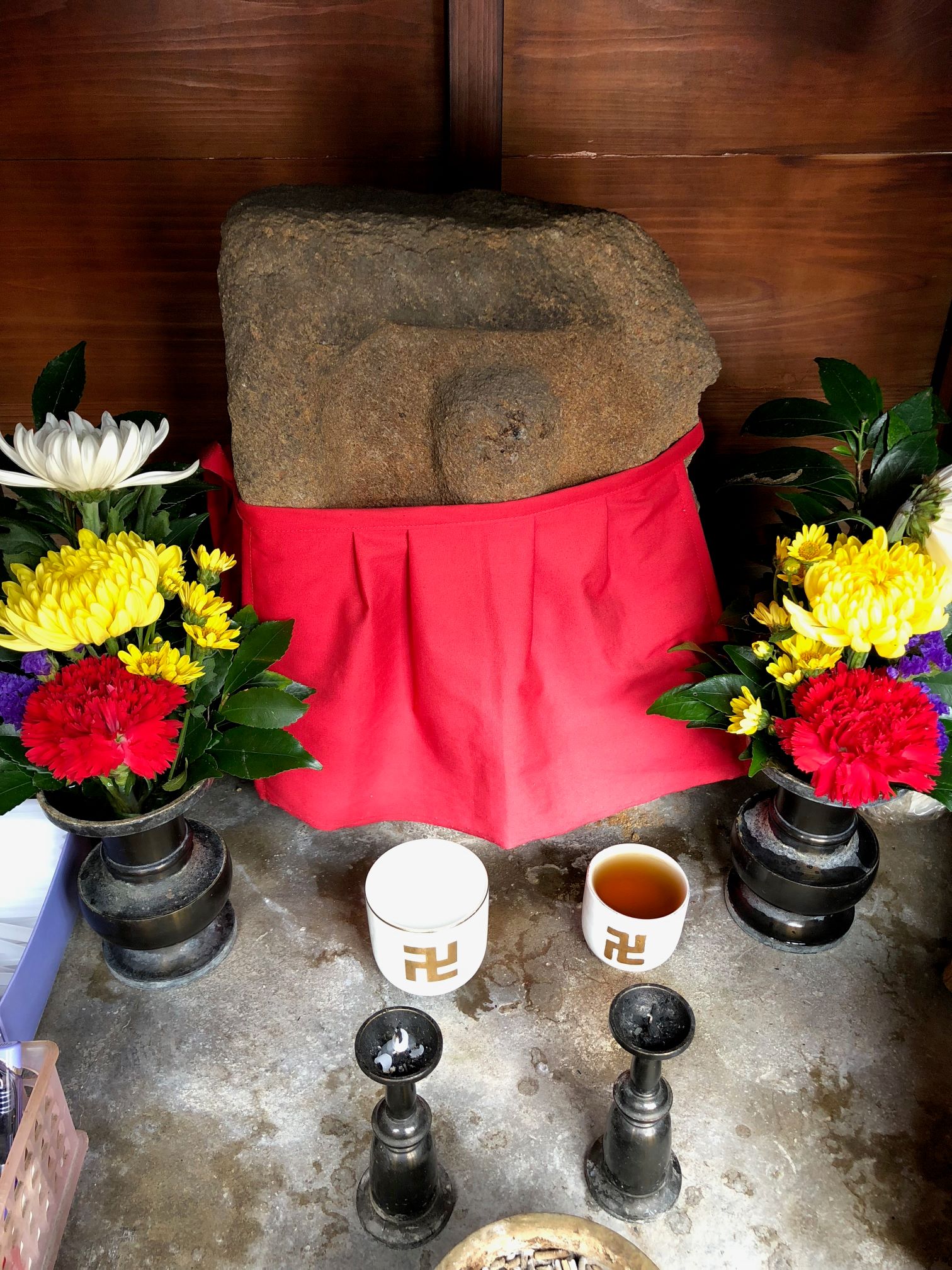
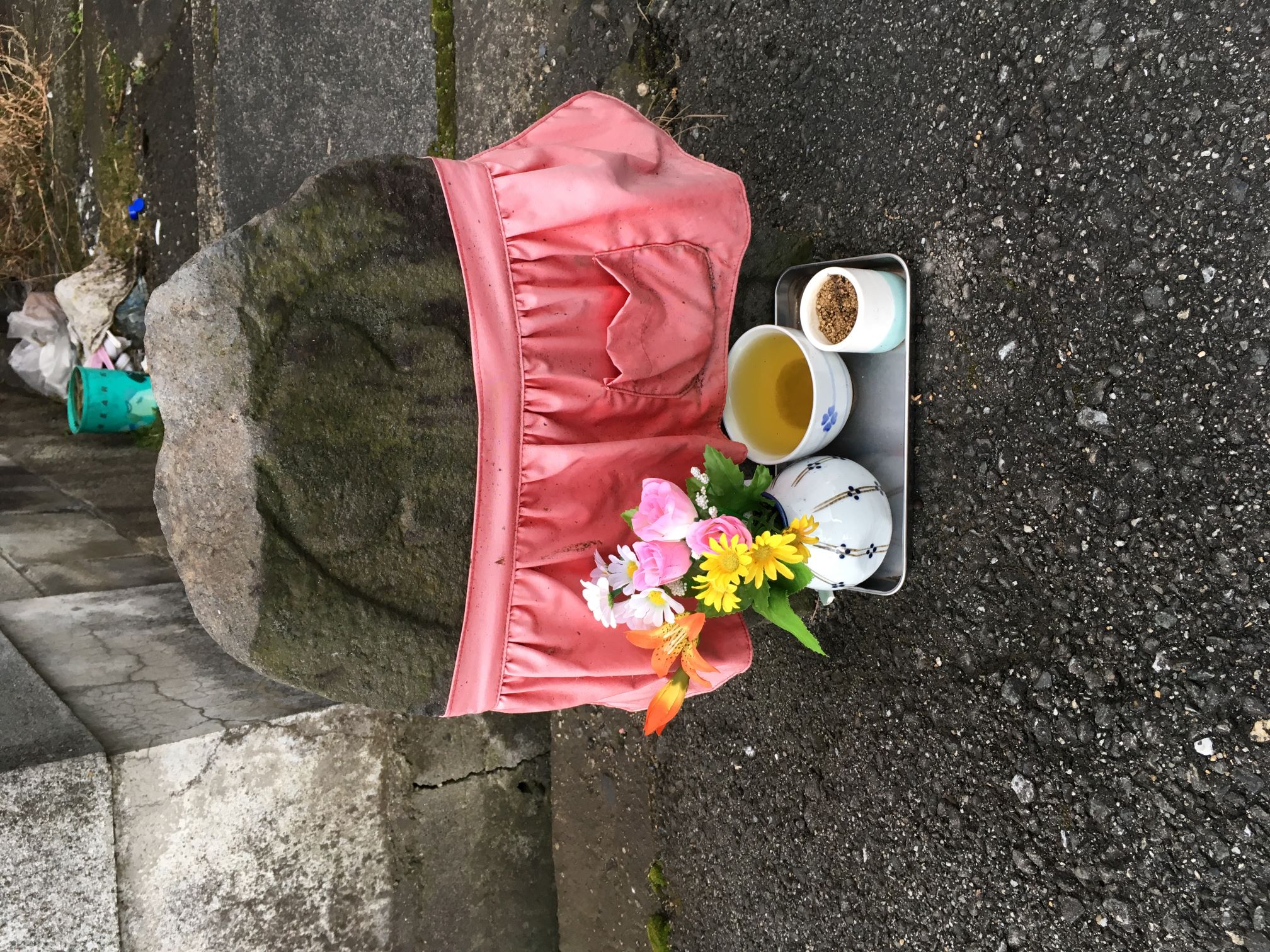
I had long had the following questions and attended the lecture hoping that some of them might finally be answered.
In the end, almost all of them were.
- Why are so many Jizo statues enshrined in Nara?
- And how far does this phenomenon extend geographically?
- Regarding the box-shaped stone Buddhist images containing extremely simplified human figures:
- What is the correct name for them?
- They seem unique to Nara, but are they really?
- What period do they date from?
- Are they actually Jizo in the first place?
Professor Sagawa’s Lecture
Below is a summary of Professor Sagawa’s lecture in bullet-point form.
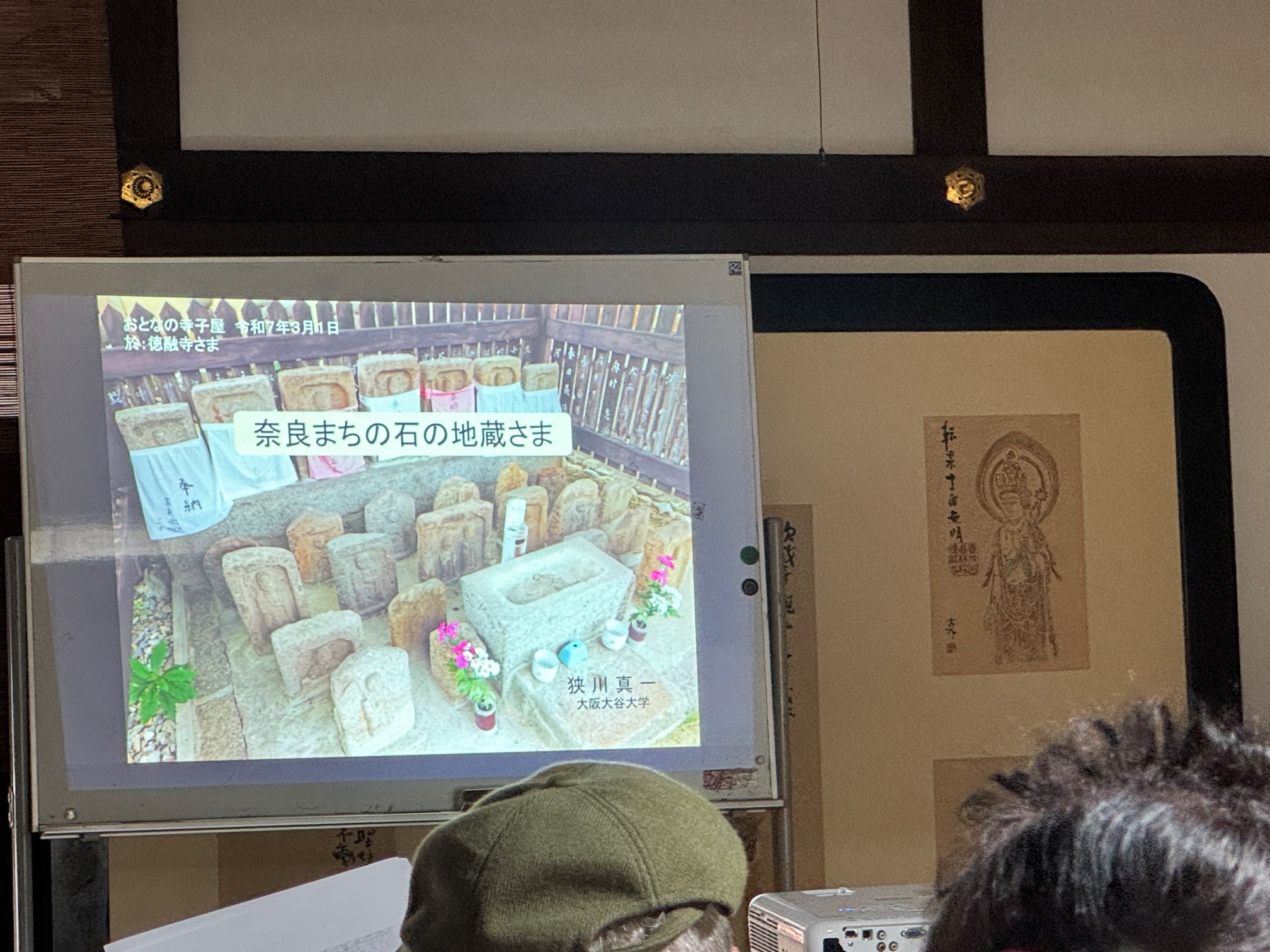
Overview of Jizo Worship in Naramachi
- The Ten Kings and Jizo belief
- At the root of Jizo worship is the belief that Jizo saves people from hell.
- Jizo is the only bodhisattva who enters hell itself to rescue the dead.
- The Ten Kings preside over a series of posthumous judgments corresponding to the ten memorial services held through the second anniversary of death, determining the fate of the deceased.
- The memorial rites performed by the living can be understood as support or prayers offered from this world during those judgments.
- These two traditions became combined into a belief system centered on the Ten Kings and Jizo.
- At the root of Jizo worship is the belief that Jizo saves people from hell.
- Jizo in Nara
- Jizo at temples
- The largest Jizo statue is at Fukuchiin Temple.
- The stone niche Jizo at Jurinin Temple is surrounded by reliefs of the Ten Kings.
- The oldest known image depicting the Ten Kings together with Jizo is at Shin-Yakushiji Temple. Similar examples can also be found at Gokojiji and Kukaiji.
- Byakugoji Temple was a major center of Ten Kings–Jizo worship.
- Jizo at temples
- Characteristics of street-corner Jizo
- Groups of Jizo stone images are enshrined throughout individual neighborhoods, with in principle one such group for each neighborhood.
- Jizo statues are often dressed with red bibs.
- Originally, this practice expressed the hope that the scent of a child who had died young would be transferred to the Jizo, so that the child might be rescued in hell.
- Today, the bibs are more generally associated with personal wishes and prayers.
- The stone monuments found in these groups tend to belong to similar categories, including stone niche images or “box Buddhas,” boat-shaped five-element pagodas, and comb-shaped grave markers.
- Some of the larger examples are thought to date as far back as the Nanbokucho period, such as those in Kawaramachi and Kyobate, or even the Kamakura period, such as one in Nishikitsuji.
Historical Development of Stone Buddhist Monuments in Nara
- Changes in funerary practices in Naramachi
- In the past, there were places outside Nara where bodies were simply abandoned, but in Naramachi the idea of burial and memorialization became established relatively early.
- In Kyoto, for example, bodies were sometimes left along the Kamo River and monks poured oil over them and burned them. Buddhist funerals in the later sense had not yet become standard.
- In the Kamakura period, Eison of Saidaiji, working through the Shingon Risshu school, helped spread the idea that the dead should be properly memorialized.
- This understanding also spread into Naramachi from Gangoji, helping establish a broader consciousness of memorial rites for the dead.
- Before the Edo period
- Community identity was strong, and each neighborhood maintained grave markers and jointly conducted funerals and memorial rites.
- The bodies themselves were not buried within the neighborhood. Only the grave markers were enshrined there and used for memorial services.
- Burial grounds existed to the north of Nara—possibly around Kurokamiyama, though I could not read the place name clearly—as well as around Aburasaka and Saihoji, Daianji, and Byakugoji.
- Kasuga’s Ryujin Pond, Kubikiri Jizo on Takisaka, and the Jigokudani area were also places where bodies were discarded.
- Memorial services were generally held only until around the second anniversary.
- Forms of grave markers
- Before the 17th century: stone niche images, or “box Buddhas”
- These consisted of square, box-shaped stones with Buddhist figures carved into them. Originally they had roofs, but some roofs were probably made of wood and have since disappeared.
- Most do not bear dates.
- Examples with inscribed dates have been found in Iga-Ueno, including examples from the Bunki and Eisho eras, confirming that this form existed in the early 16th century.
- The earliest examples were large.
- A large box Buddha at Shomyoji is thought to date from the Nanbokucho period.
- During the Sengoku period, smaller examples began to be mass-produced.
- Around this time, even people from lower social strata increasingly began to erect gravestones.
- Townhouse residents in Nara were already doing so.
- Large numbers survive at Shomyoji.
- Some depict a single figure, others two. The principal figure varies and may be Jizo, Amida, or another deity.
- The site of Tamon Castle had previously been a burial ground, and stone Buddhist monuments were still being unearthed when Wakakusa Junior High School was built.
- Stone images unearthed during the construction of Tamon Castle were taken to Shomyoji.
- Others were used as stones in the castle walls and later transferred to Yamato-Koriyama Castle.
- Yamato-Koriyama Castle also incorporated stones originating from Zuto and the Rajomon Gate.
- The box Buddha is a form distinctive to Nara.
- Different regions developed their own local types, such as single-stone five-element pagodas elsewhere and boat-shaped halos in Kyoto.
- Conclusion: Box Buddhas were grave markers used by townspeople from the late medieval period, especially up to the 16th century, with larger precedents extending back to the Nanbokucho period.
- These later came to be enshrined in neighborhood Jizo halls and similar places.
- 17th century: boat-shaped five-element pagodas
- These consist of boat-shaped stones bearing a five-element pagoda in relief.
- The merit of the Buddhist pagoda was invoked to guide the deceased into the next world.
- Stone materials
- Gray stone that rings with a metallic sound when struck came from Kasugayama.
- White examples are granite.
- These monuments often contain dates and posthumous Buddhist names, allowing their chronology to be studied.
- Comparisons have been made among Gangoji in the urban center, the cemetery at Kizu—which was rural but also a port and transportation hub—and Nakayama Nenbutsuji, which was more predominantly rural.
- They were produced from around 1520 to 1760, peaking around 1650. Their numbers rose during the later phase of the box Buddha tradition, while box Buddhas themselves declined.
- Similar trends appear regardless of the character of the settlement.
- Comparisons have been made among Gangoji in the urban center, the cemetery at Kizu—which was rural but also a port and transportation hub—and Nakayama Nenbutsuji, which was more predominantly rural.
- These consist of boat-shaped stones bearing a five-element pagoda in relief.
- Before the 17th century: stone niche images, or “box Buddhas”
- From the 18th century onward
- The temple-parishioner system became established.
- Originally intended partly to suppress Christianity, the system used Buddhist affiliation as a means of population control.
- The shogunate assigned temples the role of managing ordinary people as parishioners.
- Temples increasingly took responsibility for funerals and memorial services, while community-based funerary rites within individual neighborhoods declined.
- Graves increasingly came to be established at temples.
- Grave markers shifted toward the comb-shaped form.
- Posthumous names and dates of death became central. The symbolic power of the pagoda itself was no longer necessary; the posthumous name was sufficient.
- The posthumous name was placed in the center, making the identity of the deceased increasingly important.
- Dates of death also mattered because memorial services such as the thirteenth anniversary had to be scheduled and remembered.
- Memorial practices became more individual and family-centered, and married couples increasingly shared graves.
- Marriage came to be understood more strongly as an alliance between households—rather than, as today, between individuals.
- A couple’s grave came to symbolize one generation of a household.
- Boat-shaped stones did not provide enough space for all this information, whereas comb-shaped grave markers provided room for dates along the sides.
- The reverse could also record who commissioned the grave.
- Older neighborhood stone Buddhist images and grave markers continued to be enshrined.
- This explains why box Buddhas and boat-shaped five-element pagodas are common in these neighborhood groups, while comb-shaped grave markers are relatively rare.
- At first, when their original identities were still remembered, they were modestly venerated as the graves of distant ancestors.
- Over time, people no longer knew exactly what they were, but continued to care for them because they belonged to the neighborhood.
- Eventually, they came to be understood simply as “Jizo.”
- By around the late Edo or early Meiji period, the custom of Jizo Bon became established in a form closer to what we know today.
- Posthumous names and dates of death became central. The symbolic power of the pagoda itself was no longer necessary; the posthumous name was sufficient.
- The temple-parishioner system became established.
- In the past, there were places outside Nara where bodies were simply abandoned, but in Naramachi the idea of burial and memorialization became established relatively early.
Conclusion
- The Jizo of Naramachi were originally gravestones maintained and memorialized by neighborhood communities.
- Characteristic forms include the 16th-century box Buddha and the 17th-century boat-shaped five-element pagoda.
- With the establishment of the temple-parishioner system during the Edo period, temples increasingly came to manage ordinary people, and the creation of new neighborhood-based memorial sites declined.
- Existing stone Buddhist monuments remained in place and gradually came to be worshipped as Jizo. Today, they are commonly understood as protectors of children.
Reflections After the Lecture
It was well worth traveling all the way from the Kanto region to attend.
Almost everything I had wanted to know became clear.
- Why are so many Jizo enshrined in Nara?
→ They were originally grave markers for local residents before the Edo period.- And what is the geographical extent of this practice?
→ The same origin may apply primarily to the townhouse districts of Naramachi. Rural villages may have followed different patterns.
- And what is the geographical extent of this practice?
- Regarding the box-shaped stone images containing highly abstract human figures
- What is the correct name?
→ Sekiganbutsu—stone niche Buddhist images—or “box Buddhas.” - They seemed unique to Nara. Are they really?
→ Examples have also been found in places such as Iga, but it is reasonable to regard them as a form characteristic of the Nara region. - When were they made?
→ They are a form dating from the 16th century and earlier. - Are they actually Jizo?
→ Once the figures became highly abstract, it is often impossible to identify the deity. Earlier, larger examples include not only Jizo but also Kannon and Amida, so they cannot all be classified as Jizo. However, there is no doubt that from the early modern period onward, they came to be enshrined as Jizo.
- What is the correct name?
Although I still did not learn exactly why these regional differences developed, the distinctive features I had sensed in Naramachi’s stone Buddhist monuments and Jizo statues turned out to correspond very closely with the observations of professional researchers. That gave me confidence in what I had been seeing through our fieldwork.
At the same time, resolving these questions created new ones—for example, how widely the distribution of box Buddhas actually extends.
It was an extremely valuable lecture and provided a great deal of useful information.
== Addendum ==
Afterward, I submitted a reference inquiry to the Nara Prefectural Library and Information Center, and they kindly provided bibliographic sources supporting the content of Professor Sagawa’s lecture.
On the Miniaturization of Box Buddhas
- In Shinichi Sagawa, ed., The End of Medieval Graves and Stone Monuments, Koshi Shoin, 2020, Sagawa notes that “it is generally known that stone pagodas tended to become smaller and increasingly mass-produced toward the later medieval period,” and describes a collaborative research project undertaken to demonstrate this empirically.
The Theory That Box Buddhas and Boat-Shaped Five-Element Pagodas Were Neighborhood Grave Markers
- Regarding five-element pagodas in general, Itaru Chijiwa writes in Encyclopedia of Japanese Folklore, Vol. 2, Yoshikawa Kobunkan, 1999 that, from the latter half of the medieval period, particularly in the Kinai region, small single-stone five-element pagodas became common, and that examples inscribed with the Buddhist names of individuals or couples increasingly took on the character of grave markers.
- According to Sagawa’s “The Religious Environment of Medieval Urban Nara,” in Medieval Urban Studies Association, Considering the ‘Religious City of Nara’, Yamakawa Shuppansha, 2017, halls in Naramachi containing collections of box Buddhas, boat-shaped five-element pagodas, and similar monuments contain material dating from before the establishment of the temple-parishioner system, especially the 16th and 17th centuries. These halls are owned and managed by the neighborhoods and exist in nearly every neighborhood.
- For the dating of box Buddhas and their development as grave markers, Sagawa’s “Aspects of Cemeteries in the Sengoku Period,” in Masatoshi Ono and Mitsuo Hagiwara, eds., The Archaeology of the Sengoku Period, Koshi Shoin, 2003, is cited as a key source.
- In Asei Sato, An Archaeological Study of the Medieval City of Nara, Yoshikawa Kobunkan, 2022, pp. 162–165, Sato refers to Sagawa’s theory and argues that some halls and hermitages rooted in local communities developed into temples, partly under the influence of the expansion of newer Buddhist movements such as the Jodo school.
Chronology of Boat-Shaped Five-Element Pagodas
- The histogram discussed in the lecture appears on p. 59 of Bulletin of the National Museum of Japanese History, Vol. 111, 2004.
- On p. 100 of An Archaeological Study of the Medieval City of Nara, it is noted that as cemetery systems became increasingly visible in the 16th century, “in addition to the existing five-element pagodas, small boat-shaped five-element pagodas appeared. Their number increased explosively from the mid-16th century onward.”
Disposal of Bodies and Memorial Graves
- Sagawa also discusses this point in “The Religious Environment of Medieval Urban Nara,” in Considering the ‘Religious City of Nara’, Yamakawa Shuppansha, 2017.
- In Shinichi Sagawa, The Archaeology of Medieval Graves, Koshi Shoin, 2011, pp. 99–102, he suggests that while wealthy people deposited remains at Gangoji Gokurakubo, members of the lower classes were sometimes abandoned on the outskirts of the city.
- Shinichi Sagawa, ed., Graves and Funerary Practices in the Medieval Period, Koshi Shoin, 2007 contains five essays on issues surrounding abandoned corpses, including Sagawa’s own “Abandoned Burial and Medieval Graves as Seen in Paintings.”